
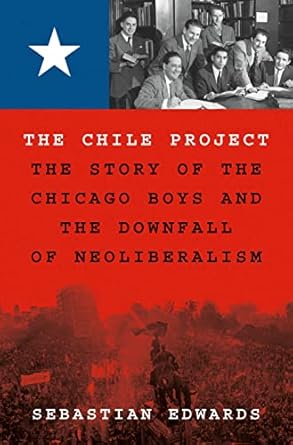
Any e book that intends to offer an entire account of a chapter overlaying virtually 70 years within the historical past of concepts is an bold achievement by itself, particularly when it’s centered round a fuzzy idea like neoliberalism. If such a e book additionally makes an attempt to cowl many years of financial historical past, discussing the evolution of policymaking and the mental and political debates that formed it, one would most likely fear that the creator is making an attempt to perform an excessive amount of. Now, add that the creator will strive to take action whereas navigating murky waters, surrounded by the historical past of a violent dictatorship and the general context of Latin American politics of the Chilly Battle period. It looks like a recipe for failure.
But, to the good advantage of his readers, Sebástian Edwards accomplishes all this brilliantly. The Chile Venture: The Story of the Chicago Boys and the Downfall of Neoliberalism is nothing in need of a monumental achievement.
Venture overview
A local Chilean himself, Edwards obtained his bachelor from the Universidad Católica de Chile (Pontifical Catholic College of Chile, hereinafter PUC), labored as a younger economist in Allende’s authorities division of financial planning, and witnessed a well-known British scientist who was visiting Chile to name out the insanity of the duty: “my friend, you really want to determine true, social, equilibrium prices for over three thousand goods, with a fifteen-sector input-output matrix?” (p. 62). An opponent of Pinochet’s regime, he fled Chile in 1977, and acquired his graduate coaching in economics on the College of Chicago, the place he grew to become “colleague, coauthor, and close friend of [Arnold] Al Harberger, who is the intellectual father of the Chicago Boys.” (p. 23).
Whereas, because the subtitle suggests, The Chile Venture is especially a e book concerning the story of the Chicago Boys and the rise and fall of neoliberalism in Chile, it is usually a story of Chile’s fashionable financial historical past, informed in three elements.
The primary half (Chapters 1–3) units the stage for the rise of neoliberalism; from the deal between the College of Chicago and PUC, to Salvador Allende’s “one thousand days of socialism.” Edwards supplies a cautious definition for neoliberalism:
- “I define neoliberalism as a set of beliefs and policy recommendations that emphasize the use of market mechanisms to solve most of society’s problems and needs, including the provision and allocation of social services such as education, old-age pensions, health, support for the arts, and public transportation. […] neoliberalism is the marketization of almost everything” (p. 14, emphasis unique).
Half two (Chapters 4–9) begins with Pinochet’s rise to energy and analyzes the financial insurance policies over the size of the dictatorship (1973–1990). This contains debates over the preliminary shock therapy and Milton Friedman’s controversial visits to Chile (Ch. 4–5), the struggles for command over coverage inside the regime (Ch. 6), and the small print about their eventual implementation (Ch. 7). Chapter 8 offers with the deep forex disaster of 1982, and the second half ends with an evaluation of the second spherical of “pragmatic” reforms that observe the disaster in Chapter 9. The latter additionally explores the rising affect of Arnold Harberger, who was doubtless the person influencing the “pragmatic” half. Half two shines as a result of concept and historical past come collectively to ship a captivating story that reads virtually like a novel.
The ultimate a part of the e book (Chapters 10–16) covers the autumn of Pinochet’s regime and the sequence of financial reforms that continued below democracy. This half tells a narrative of the mannequin that led to Chile’s financial miracle, but in addition of its downfall. It began with a sequence of protests and riots in 2019 that ultimately led to an bold try and draft a completely new structure that in the end failed. Whereas the tip appears sure, Edwards additionally delves into its potential causes, drawing from a perceived widespread sentiment of unhappiness: “large numbers of Chileans lived in fear of retrogressing both socially and economically and rejoining the ranks of the poor,” (p. 209) which grew to become referred to as the malestar (“malaise”) speculation.
“Edwards’ first-hand testimony, combined with his use of archival material, provides a rich historical account.”
Edwards’ first-hand testimony, mixed together with his use of archival materials, supplies a wealthy historic account. Many of those occasions are surrounded by controversy, and a few have been elevated to the standing of outright myths. Edwards acknowledges upfront the constraints of what the archive tells us and is obvious when he’s filling the gaps together with his conjectures. The result’s an especially well-balanced narrative that – maybe aside from a extra technical chapter coping with the forex disaster – is accessible for a extra normal viewers. Thus, the primary contribution of the e book is to offer new (and, in some circumstances, arguably definitive) historic accounts of key occasions of Chile’s latest financial historical past.
Clarifying misconceptions
The settlement between the College of Chicago and the Universidad Católica de Chile (PUC) is the topic of an necessary false impression. It’s typically portrayed as a nebulous U.S. plan to coach economists particularly to run Pinochet’s financial coverage. But the plan was drafted in 1954–55, a decade and a half earlier than even Allende rose to energy, to not point out Pinochet.
Edwards attracts from archival data and divulges that the U. Chicago-PUC deal was, in some ways, unintended. The deal was intermediated by the Worldwide Cooperation Administration (ICA), and it first aimed on the Universidad de Chile, the nation’s primary public college, not PUC. Nevertheless, “the [U. de Chile] faculty was reluctant to enter into a partnership with an American school, and particularly with the University of Chicago, with its reputation of being a white knight for monetarism, free trade, deregulation, and free markets” (p. 29). When the ICA reached out to PUC for the same deal, each U. Chicago and PUC had considerations concerning the compatibility of the college’s spiritual affiliation. Ultimately, PUC’s dean manifested their “desire is to sign an agreement between our university and an institution in the United States, such as the University of Chicago, or the Massachusetts Institute of Technology.” (quoted in pp. 30–31). Thus, it was not clear from both the U.S. or Chilean facet that the College of Chicago can be in the end paired with PUC.
The federal government of Salvador Allende can be the topic of many misconceptions. Edwards acknowledges that a part of the confusion stems from the truth that Allende was from the Socialist (and never from the Communist) Social gathering, which led authors to mistakenly painting him as a comparatively average candidate despite the fact that, in Chile, the Socialists have been rather more to the left and had shut ties with Cuba and North Korea.
The e book presents an in depth overview of Allende’s financial insurance policies. As an illustration, Edwards reveals that the federal government’s grasp over the financial system went considerably past the well-known nationalization of U.S.-owned copper mines. It additionally nationalized the banking sector and enforced its proper to take management, for an undetermined interval, of a whole bunch of factories producing items “in short supply.” This brief provide was typically staged by unions stopping the manufacturing unit flooring and creating synthetic shortages. He notes that each import required a license, with some tariffs reaching 250 %. He additionally describes how perverse and arbitrary mechanisms have been used to set worth controls, which led to confiscation of products, typically imposed enormous fines, and, generally, despatched “speculators” to jail.
Turning to controversy
Half II of the e book sheds gentle on extra controversial subjects: the Chicago Boys’ involvement within the Pinochet regime. Some early accounts attributed the financial plan to the CIA and positioned Arnold Harberger and Milton Friedman as maybe main contributors. Edwards once more relied on archival supplies and interviewed a number of of the Chicago Boys themselves to supply, it appears, a balanced account.
The plan was referred to as El Ladrillo (The Brick), resulting from its sheer dimension. The controversy is whether or not the plan was knowingly drafted by the economists for Pinochet. What is understood is that the plan was written earlier than the coup, in 1972, as a blueprint for Chile’s improvement within the subsequent presidential elections; eleven of the Chicago Boys contributed particular person chapters.
On the one hand, it seems that solely certainly one of them, Emilio Sanfuentes, then related to the Chilean suppose tank Centro de Estudios Sociales y Económicos, had contact with a retired high-ranking navy official who labored for a non-public conglomerate and was excited about such a plan. Edwards additionally remembers that a lot of the content material of the plan have been fairly just like an earlier financial plan written by a number of the similar Chicago Boys for presidential Jorge Alessandri, a center-right candidate who confronted Salvador Allende in 1970, and have been additionally seen as extension to experiences that two of the economists (Alvaro Bardón and Sergio Undurraga) have been writing for the opposition, together with the average Christian Democrats and former president Eduardo Frei Montalva.
Edwards highlights that the latter plan, El Ladrillo, included extra economists, a few of them centrists. The primary editor of the plan, Sergio de Castro, argued that to achieve the help of Christian Democrats, it even included recommendations of “Yugoslavia-style firms, where workers owned the companies and participated actively in their management” (Arancibia Clavel and Balart Páez 2007, p. 144). He additionally emphasizes the concept solely Emilio Sanfuentes had connections with navy officers.
Then again, there’s proof that every one authors met in a resort to debate it with the retired naval officer liaison. Edwards acknowledges that it’s in the end a “mystery that will never be fully resolved” (p. 80), however doesn’t draw back from conjecturing that it’s doubtless that the remainder of the economists knew, at the very least to some extent, that the plan was meant for the navy.
In what follows, Edwards supplies a complete evaluation of the insurance policies contained within the plan. For each coverage space (e.g., healthcare), he compares what the plan proposed and what was ultimately carried out by the navy, creating an especially helpful information to researchers. One other assertion to Edwards’s thoroughness is that he connects some coverage decisions to theoretical debates that have been going down on the time, each in Chile and elsewhere.
Friedman’s function
Chapter 5 presents a fastidiously researched examination of Milton Friedman’s involvement with the Chicago Boys and his two visits to Chile in the course of the navy regime. Friedman first visited Chile between March 20 and 27, 1975, and met with Pinochet on the 21st. Of their one-hour assembly, Friedman argued—in seemingly broad strokes—that the nation wanted a “shock therapy” to battle rampant inflation that had reached 350% a yr.
“Indeed, the director of intelligence was spying on the Chicago Boys to convince Pinochet that ‘the Chicago Boys were not true patriots and that their only interest was to privatize state-owned enterprises at low prices in order to have private investors (including their friends and associates) own and run key strategic industries.’”
Within the following days, Friedman met with Chile’s enterprise elite, gave a lecture to a gaggle of navy officers, and gave a number of interviews to newspapers. Friedman once more argued for shock remedy. Edwards collects a number of the questions requested by the enterprise viewers and Friedman’s reply to them, concluding that businessmen wished the identical gradualism they have been used to.
The navy was principally in opposition to privatizations and reducing pointless personnel wanted for the fiscal adjustment. Certainly, the director of intelligence was spying on the Chicago Boys to persuade Pinochet that “the Chicago Boys were not true patriots and that their only interest was to privatize state-owned enterprises at low prices in order to have private investors (including their friends and associates) own and run key strategic industries.” (p. 100).
Whereas critics deal with Friedman because the mastermind behind Chile’s 1975 Restoration Plan, the Chicago Boys themselves downplayed Friedman’s affect. A number of biographies don’t point out Friedman’s go to to Chile in any respect. Earlier analysis additionally advised that he didn’t affect the plan (see Caldwell and Montes, 2015, p. 271). Extra broadly, Friedman defended himself by arguing that assembly a politician isn’t the identical as advising him, and by noting that he additionally met with Chinese language chief Zhao Ziyang in 1988. Furthermore, what he mentioned about Chile was a mere reflection of broad classes from his educational analysis, not particular recommendation.
Nevertheless, Edwards makes a convincing case that Friedman is answerable for the restoration plan, referring to the significance of a “before Friedman and an after Friedman.” (p. 97, emphasis unique). The Chicago Boys would doubtless have proposed the identical plan regardless, however Friedman’s go to weighed the scales in favor of their plan over the extra gradualist strategy that was being put forth by businessmen and navy officers.
What to make of the Chicago Boys?
Recurring in Edwards’ narrative within the third and last a part of the e book is that, regardless of the breadth of the reforms carried out throughout the regime, a lot else was additionally achieved after the return to democracy to deepen and prolong the reforms. This continuation was typically undertaken by center-left politicians. This perception invitations reflection on the function Chicago Boys. On the one hand, their concepts undoubtedly charted the trail to larger financial freedom, a lot wanted in Chile after Allende’s populist insurance policies.
Then again, Chile’s expertise highlights the constraints to financial progress and prosperity below a dictatorship. Latest empirical analysis has analyzed this problem in Pinochet’s Chile from two completely different sides. Escalante (2022) exhibits that the Chilean GDP per capita underperformed for at the very least the primary 15 years following the coup. Arenas, Toni, and Paniagua (2024) additionally query the timing of the “Chilean miracle”, arguing that it solely actually developed following the return to democracy. Certainly, different Latin American improvement “miracles” (in Uruguay and Costa Rica) occurred and not using a related story of a liberalizing autocrat.
For extra on these subjects, see
Nonetheless, it’s plain that the Chicago Boys fully shifted the Overton window in Chile. Even when by historic accident, they reworked perceptions of insurance policies that have been unimaginable in Latin America right into a established order that endured because the nation returned to democracy. Hopefully, Chile may also endure its new challenges.
Word:
I refer the readers to one other overview of the e book by Pablo Paniagua, which offers extra extensively with Edwards’ speculation concerning the downfall of liberalism in Chile: the “malaise” speculation.
Footnotes
[1] Sebastian Edwards (2023) The Chile Venture: The Story of the Chicago Boys and the Downfall of Neoliberalism. Princeton College Press.
[2] To readers acquainted with Edwards’s work on populism (see esp. Dornbusch and Edwards, 1990), it’s no secret that Allende’s macroeconomic insurance policies have been disastrous, resulting in hyperinflation in 1973.
[3] “It is important to point out that only one of the members of the academic group [Emilio Sanfuentes] had contact with the high command of the national Navy, something the rest of us did not know about. Thus, [in September 1973,] our surprise was immense when we realized that the Junta had our document and was contemplating the possible implementation [of our suggested policies].” (De Castro, 1992, p. 11, as quoted in Edwards, p. 78)
[4] As an illustration, Edwards connects the macroeconomic insurance policies put ahead in The Brick to Albert Hirschman’s “The Dynamics of Inflation in Chile,” revealed in 1963.
[5] Edwards goes deep into the archives to light up the context of Friedman’s go to to Chile, additionally counting on Friedman’s personal recollections.
[6] Through the awarding of the 1976 Nobel Prize in Economics to Friedman, as he was about to be launched to King Carl XVI Gustaf of Sweden, a demonstrator screamed from the balcony: “Freedom for Chile! Friedman go home! Long live the people of Chile! Crush capitalism!”
[7] Friedman additionally visited Chile a second time, in November 1981, to attend a gathering of the Mont Pèlerin Society.
References
Arancibia Clavel, P., and Balart Páez, F. (2007). Sergio de Castro: El arquitecto del modelo económico chileno. Santiago, Chile: Editorial Biblioteca Americana.
Arenas, J., Toni, E., & Paniagua, P. (2024). Improvement on the Level of a Bayonet? Difficult Authoritarian Narratives in Latin-American Development. https://dx.doi.org/10.2139/ssrn.5026133
Caldwell, B., and Montes, L. (2015). “Friedrich Hayek and His Visits to Chile.” Overview of Austrian Economics 28(3): 261–309.
De Castro, S. (1992). El ladrillo: Bases de la política económica del gobierno militar chileno. Santiago, Chile: Centro de Estudios Públicos.
Escalante, E. E. (2022). The affect of Pinochet on the Chilean miracle. Latin American Analysis Overview, 57(4), 831–847.

