
A latest submit argued that housing affordability shouldn’t be so dangerous as it would seem when house costs are adjusted for all related components, reminiscent of dimension, high quality, and family earnings development. Whereas homes have develop into dearer in {dollars}, they’re additionally considerably larger and nicer, and the typical family has considerably extra earnings.
We acknowledge, nevertheless, that there’s a housing affordability drawback, significantly for working- and middle-class folks in sure metro areas. Bankrate discovered that the family earnings wanted to afford a median-priced American house rose by 50% simply since 2020, to $117,000.
The economics of housing affordability may be very easy. If costs have gone up, both demand has shifted proper, provide has shifted left, or some mixture of the 2. Whereas provide constraints are the key wrongdoer within the affordability drawback, we wish to acknowledge that patrons are partly accountable for the market shifts that we’ve seen—it takes two to tango. Housing is a standard good with a long-run earnings elasticity of demand shut to at least one, which means housing demand rises in tandem with family earnings development.
To carry costs down, we want builders to shift the housing provide curve “out and right” by a bigger issue than patrons are shifting the demand curve. Builders know precisely what this could take: much less restrictive zoning (particularly for multifamily models), simpler licensing and allowing processes, much less stringent constructing codes and vitality requirements, freer markets in labor and supplies, and maybe a client acceptance of smaller, less complicated houses.
With our mixed expertise in house constructing and financial evaluation, we see three main components driving housing unaffordability: zoning, constructing codes, and residential sizes.
Virtually all U.S. jurisdictions impose zoning laws that restrict, generally severely, the variety of houses that may be constructed. Within the pursuit of security and vitality effectivity, ever-more-stringent constructing codes require costlier building strategies and supplies. America’s builders have moved away from smaller, extra austere starter houses to large, gaudy “McMansions.”
Zoning Prevents Reasonably priced Housing
Economists have lengthy acknowledged that zoning restrictions are one of many largest components holding again housing provide development. City-planner-turned-anti-zoning-crusader Nolan Grey wrote the authoritative critique of zoning, Arbitrary Strains (excellently reviewed by David Henderson). Grey spells out precisely how zoning raises housing prices:
The obvious manner is by blocking new housing altogether, whether or not by prohibiting reasonably priced housing or by way of express guidelines restraining densities. This ends in much less housing being constructed, ensuing within the supply-demand mismatches we see in most US cities at this time. A subtler manner that zoning drives up housing prices is by forcing the housing that’s constructed to be of a better high quality than residents may in any other case require, by way of insurance policies reminiscent of minimal lot sizes or minimal parking necessities. Past these written prohibitions and mandates, zoning typically raises housing prices just by including an onerous and unpredictable layer of assessment to the allowing course of. (p. 52–53)
There’s loads of proof supporting the idea that zoning performs a serious half in limiting housing provide and elevating house costs. Exhibit A is Houston, probably the most well-known instance of a non-zoned massive metropolis, which, consequently, is without doubt one of the most reasonably priced massive cities in america. No zoning means Houston can simply add homes, significantly in response to even small worth will increase. As Grey notes, “Houston builds housing at nearly three times the per capita rate of cities like New York City and San Jose… in 2019, Houston built roughly the same number of apartments as Los Angeles, despite the latter being nearly twice as large.” (p. 144) This bigger provide elasticity in Houston permits the housing inventory to develop in tandem with demand and accordingly retains worth will increase in verify. For large cities, Houston is tops in affordability as measured by the ratio of median house costs to median family incomes.
Constructing Codes Elevate Prices
Persevering with a household custom begun by Grandpa Watts in 1948, we constructed a number of spec houses in 2005–2006, raking in money till we have been derailed by the emergence of the subprime mortgage disaster.
Joel began constructing once more after an nearly 10-year hiatus, whereas Tyler headed off into tutorial economics. Touring one in every of Joel’s builds after the restart, Tyler observed that each one exterior partitions have been now constructed with 2×6 lumber, as a substitute of 2x4s as had been normal follow because the creation of stick framing. Joel indicated this was on account of modifications within the constructing code, primarily for the aim of including extra exterior insulation and making houses extra vitality environment friendly. This code improve was simply one of many extra noticeable examples of a gentle pattern of ever-more-stringent necessities, often aimed toward marginal enhancements in security and vitality effectivity.
A collection of research commissioned by the Nationwide Affiliation of Residence Builders (NAHB) tracked the whole price affect, on a per-home foundation, of particular modifications within the Worldwide Residential Code (IRC). These research discovered that, over the 2009–2018 IRC replace cycles, code modifications elevated prices for building of typical houses in Joel’s space by an estimated $13,225 to $26,210. With ongoing updates, IRC has the potential to proceed ratcheting up prices indefinitely.
One other research by NAHB discovered that authorities laws general (zoning, constructing code, design, security, and so forth.) accounted for practically 24% of the gross sales worth of a single-family house—$93,870 when utilized to the median new house worth in 2021.
Small + Easy = Reasonably priced
Houses in america have gotten quite a bit larger because the supposed golden age of house affordability within the Fifties and Nineteen Sixties. Common house dimension grew from 1,500 sq. ft in 1960 to a peak of two,700 within the mid-2010s. At present, new houses in america common about 2,400 sq. ft, and builders seem to have largely deserted building of small starter houses.
Houses beneath 1,400 sq. ft, as soon as the bulk, have collapsed to nicely beneath 10% of latest house begins—although the per-household head depend shrank considerably since 1960.

;
Any push for extra affordability ought to emphasize smaller and less complicated homes—true starter houses. On the 2024 nationwide common building price of $195 per sq. foot (together with every part besides land), at this time’s 2,400 sq. foot house prices over $200,000 extra to construct than a 1,200 sq. foot starter house would price. Take out costly facilities reminiscent of granite counters, premium home equipment, high-end trim, and so forth., and we reckon site-built houses within the 1,200 sq. foot vary, even within the priciest metros, might be constructed and offered profitably for a full $100,000 lower than at this time’s nationwide median worth of about $410,000.
So why don’t we see extra builders producing smaller, extra fundamental houses to fulfill the crying want for reasonably priced housing? Put merely, the big price burden of laws—zoning and constructing codes specifically—makes starter houses comparatively unappealing for each patrons and builders.
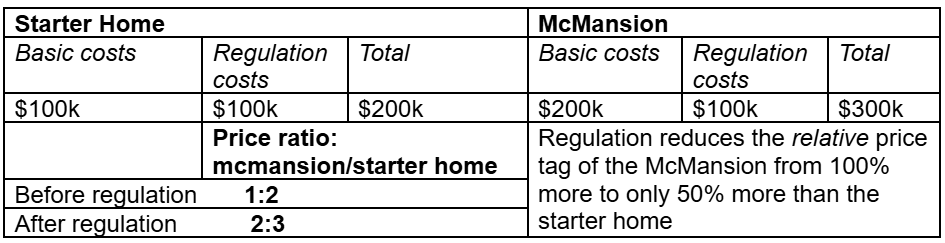
Permit us as an example by evaluating the prices of a pattern 1,200 sq. foot starter house in opposition to a high-end 2,400 sq. foot McMansion. We’ll assume the all-in prices of regulation add $100,000 per single-family house. Fundamental building prices are, roughly talking, straight proportional to house dimension and high quality. Thus, within the absence of an extraneous regulatory price burden, a 2,400 sq. foot house ought to run about double the cost-to-build of a 1,200 sq. foot house (land prices however). The prices of a strict regulatory regime, nevertheless, are usually not proportionate to house dimension and facilities, however moderately a roughly fastened quantity for any dimension house. In different phrases, regulatory compliance provides nearly the identical quantity of greenback outlay to the starter house because it does to the McMansion. The general impact is to shrink the worth hole between starter houses and McMansions, making the latter comparatively inexpensive in comparison with the previous. Economists know this because the Alchian-Allen Impact.
In a less-regulated world, a starter house is likely to be ½ the worth of a McMansion, however as soon as the regulatory burden is factored in, the starter house is as a substitute 2/3 the worth, and the bigger the fastened price of laws, the smaller this relative worth hole turns into. As the price of laws grows, the relative worth of huge, well-appointed homes declines. Unsurprisingly, builders and patrons more and more eschew comparatively dearer starter houses.
Let there be “low quality” items
The inimitable Walter Williams, our favourite econ instructor, used to say, “Low quality goods are part of the optimal stock of goods.” After all—for the way else may the fabric wants of poorer folks be met? By this, Williams didn’t imply unsafe or non-functional, however moderately made with price in thoughts. Within the case of houses, this could imply that they’re smaller and less complicated.
To make sure an abundance of lower-quality items, governments should keep away from burdensome taxes and laws that make it unprofitable and unrealistic for entrepreneurs to function within the low-end market. Sadly, for a lot of lower-income folks on the lookout for shelter, laws have priced them out of the market.
To incentivize a dependable circulate of reasonably priced housing, we might want to see governments drastically peel again cost-prohibitive guidelines and restrictions imposed by zoning and/or constructing codes. “If you build it, they will come” rings true to us, however take our phrase for it: reasonably priced houses received’t get constructed until and till governments in the reduction of this extreme regulatory price burden.
Tyler Watts is a professor of economics at Ferris State College. His brother, Joel Watts, is a homebuilder.

